
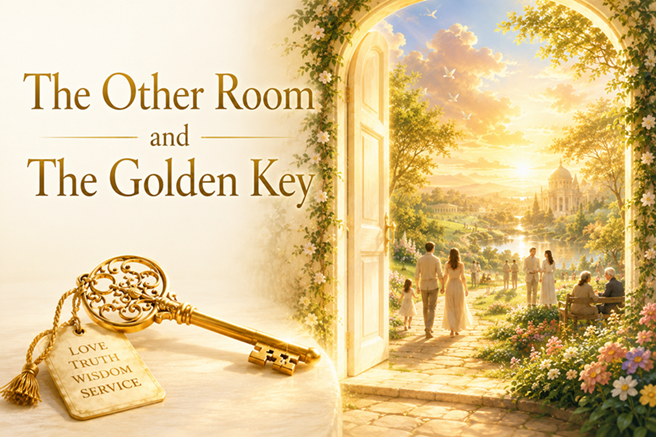
The Other Room and The Golden Key
Opening the Door to the Reality beyond Death
Introduction
Throughout history, humanity has asked the same profound questions: What happens after death? Does consciousness survive? Is there truly another life beyond this world?
In this remarkable message, Dr. Scott speaks not as a philosopher speculating from afar, but as someone who claims to have crossed the threshold himself. His words do not carry the tone of fear or religious condemnation, but rather the calm certainty of someone describing a place that is intensely alive, deeply human, and filled with meaning. `
At the heart of his message are two powerful spiritual ideas: The Golden Key and The Other Room.
The Golden Key represents the awakening of humanity’s deeper spiritual faculties — intuition, psychic sensitivity, inner perception, and spiritual understanding. According to Dr. Scott, these are not dangerous or unnatural gifts, but part of humanity’s divine inheritance. They are the key that opens the soul to a greater awareness of life.
The Other Room is his description of life after physical death. He explains that death is not an ending, but a transition — like walking from one room into another. Beyond that doorway lies a world more real, more vibrant, and more enduring than the temporary world we inhabit on Earth.
What makes this message so moving is that Dr. Scott does not describe Heaven as a place of endless solemnity or judgment. Instead, he describes a world of learning, friendship, creativity, healing, laughter, music, reunion, and love. A world where the soul finally discovers its true self.
His testimony invites us not to fear death, but to understand life more deeply.
The Message from Dr. Scott – Recording 93
Dr. Scott begins by describing his own arrival into the spirit world after leaving Earth in 1910. He explains that although he had been a respected surgeon, educated and socially established, he soon discovered that many of his earthly assumptions and attitudes were incomplete.
One of the first lessons he learned was that the spirit world is a place of profound honesty. Social status, pride, hypocrisy, and outward appearances cannot be hidden there. The soul is seen clearly for what it truly is. This realization required humility and self-examination.
Yet he emphasizes that this process was not cruel or punitive. He describes being surrounded by loving teachers and helpers who guided him patiently and compassionately. Their purpose was not condemnation, but growth.
Soon after his arrival, he became involved in spiritual work connected to the coming world wars. He explains that many souls in the spirit world tried desperately to influence humanity away from destruction and violence. When war became inevitable, they worked to inspire doctors, nurses, healers, and ordinary people to save lives and alleviate suffering.
What is striking is his compassion not only for human beings, but also for innocent animals caught in war — the horses and creatures used and destroyed by mankind’s conflicts. This reflects a vision of universal compassion extending to all living beings.
Dr. Scott repeatedly stresses that spiritual life is not passive. Growth requires effort, discipline, learning, and service. Just as musicians, artists, and scientists must train to develop their gifts on Earth, souls must continue learning and unfolding in the spirit world.
He compares the awakening of spiritual faculties to using a “Golden Key.” Humanity possesses inner abilities capable of opening the door to higher understanding, yet these gifts are often mocked, feared, or misunderstood. According to him, intuition and psychic perception are natural faculties meant to help humanity evolve spiritually.
The “Other Room” is his metaphor for life beyond death. Death, he says, is simply a doorway into another level of existence. Far from being unreal or dreamlike, the spirit world is described as more vivid, more permanent, and more meaningful than Earth itself.
In that world, souls naturally gravitate toward groups sharing similar ideals, talents, and purposes. Doctors continue studying healing, artists continue exploring beauty, and compassionate souls continue working to help humanity. There is individuality, but also harmony and cooperation.
Perhaps one of the most comforting parts of the message is Dr. Scott’s insistence that no soul is ever ultimately abandoned after death. Even those confused, selfish, or emotionally trapped eventually receive care, guidance, and love.
He also speaks beautifully about children in the spirit world — children who suffered on Earth, children lost through illness, poverty, or tragedy, and even stillborn children. He describes them as healthy, joyful, educated, loved, and nurtured in the spirit realms.
Again and again, Dr. Scott rejects fear-based religion. He says he never encountered the terrifying images often preached by religious institutions. Instead, he discovered a universe governed by love, justice, learning, balance, and spiritual opportunity.
One of the most powerful statements in the recording comes near the end:
“God is love and God’s love is expressed through His laws.”
This sentence summarizes the entire philosophy of the message.
Recommendations from Dr. Scott’s Teachings
Dr. Scott’s message contains many practical spiritual lessons for humanity.
1. Be Honest with Yourself
The spirit world, according to him, reveals the true nature of the soul. Therefore, spiritual growth begins with sincerity and self-awareness. Pretending to be morally superior or spiritually advanced serves no purpose.
2. Develop Compassion
He repeatedly emphasizes love, healing, understanding, and service. Human life gains meaning when we reduce suffering and help others.
3. Do Not Fear Death
Death is presented not as annihilation, but as transition. Fear decreases when we understand that consciousness continues.
4. Use the “Golden Key”
Human beings should nurture their spiritual awareness rather than suppress it. Intuition, inner sensitivity, reflection, prayer, and spiritual perception can help people understand life more deeply.
5. Value Human Experience
No suffering, effort, or struggle is wasted. Even painful earthly experiences can develop patience, endurance, strength, and compassion.
6. Keep Growing Spiritually
Learning does not end with physical death. The soul continues unfolding eternally.
How Can We Apply This Today?
Modern society is often dominated by materialism, anxiety, competition, and superficial identity. Many people feel spiritually disconnected despite technological advancement.
Dr. Scott’s message offers several important reminders for our time.
We Must Recover Inner Depth
People today are constantly distracted by noise, information, and external pressures. Yet spiritual understanding requires stillness, reflection, and sincerity.
We Should Live with Greater Compassion
The world still struggles with war, division, greed, exploitation, and emotional isolation. Dr. Scott reminds us that genuine progress comes through service, empathy, and understanding.
We Need Less Fear and More Hope
Many people fear aging, illness, and death. This message encourages us to see life as a continuous journey rather than a brief and meaningless existence.
Creativity Has Spiritual Value
Art, music, healing, teaching, kindness, and human connection are not trivial. They are expressions of the soul.Spiritual Growth Is Practical
Spirituality is not about escaping life. It is about becoming more honest, more loving, more balanced, and more aware in daily living.
Spiritual Reflection
“The Other Room” presents a vision of existence that is deeply hopeful without ignoring human suffering.
Dr. Scott does not deny the tragedies of Earth. He speaks openly about war, selfishness, greed, suffering, and human cruelty. Yet he insists that behind the chaos of earthly life exists a greater spiritual reality governed by love, balance, and growth.
His message suggests that Earth is not humanity’s final destination, but a temporary school where souls learn through experience. Beyond this world lies a deeper reality where truth cannot be hidden, where love continues, and where every soul ultimately has the opportunity to grow.
Perhaps the greatest comfort in his words is the idea that nothing good is ever lost:
- no act of kindness,
- no sincere effort,
- no love,
- no sacrifice,
- no endurance,
- no compassion.
Everything meaningful survives.
The Golden Key symbolizes the awakening of spiritual understanding within us now. The Other Room reminds us that life continues beyond the visible world.
Together, they form a message not of fear, but of hope.
And perhaps that is the deepest lesson of all:
That the purpose of life is not merely survival or success, but the gradual awakening of the soul into greater love, wisdom, understanding, and service to others. God bless all those who seek truth with an open heart.
Transcription of Dr Scott’s Recording
